Yield
2026 Driver Education Round 2
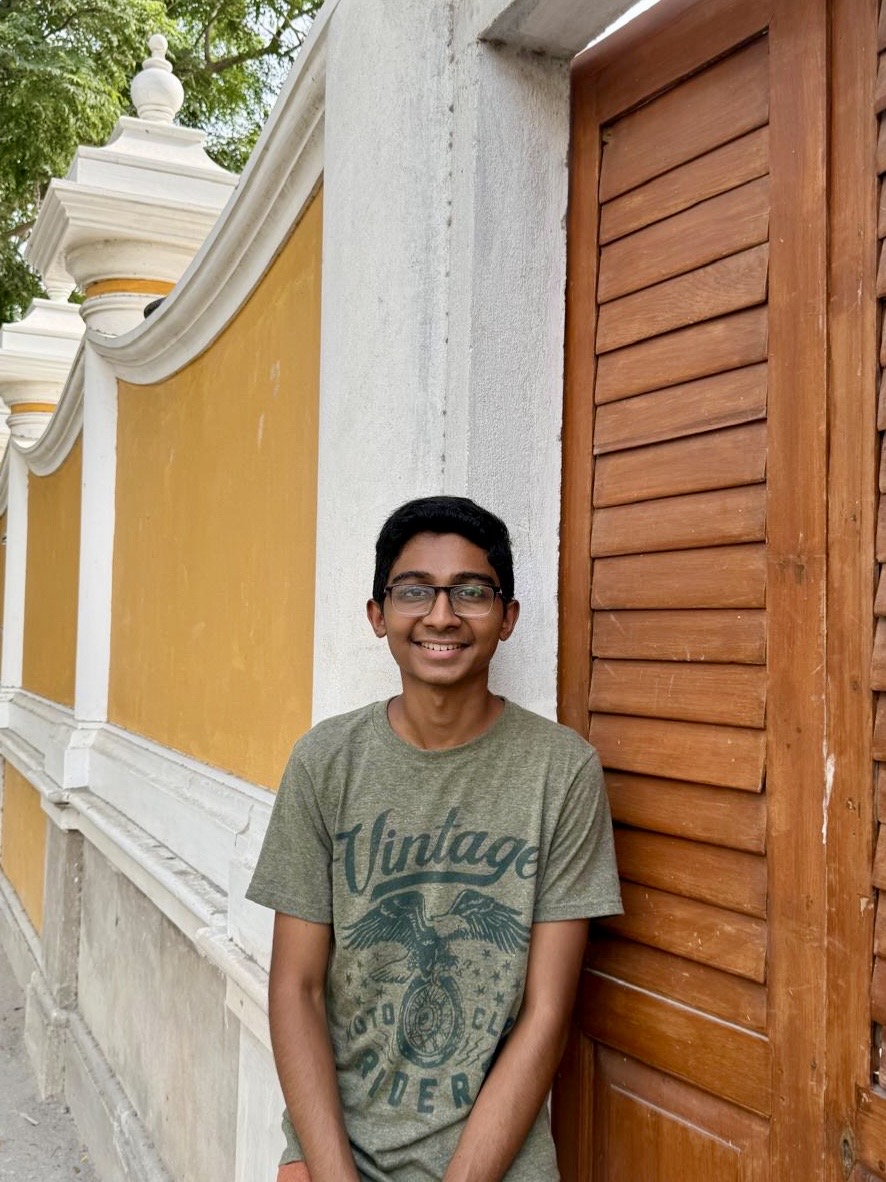
Annamalai Arunachalam
Austin, Texas
Every driver learns what a yield sign means in the first week: slow down, look, and let someone else go first. What nobody explains is how rarely the sign is really about the road. It is about patience, and about admitting that your turn is not the only turn that matters. I learned that under a bridge, in a friend’s car, in a few seconds I will never forget.
We were approaching an intersection right below the bridge, one of those spots where traffic has to yield. I was riding with a friend and another friend, talking the way you do when nothing feels like it is at stake. Then we made one fast turn, a moment before it was safe. A low car came through and slammed into the side of ours, and then hit us again. It happened two or three times in all, and I still cannot say which.
Nobody was injured, and I will be grateful for that for the rest of my life. But I can still picture the side of that car: metal torn open, the door pushed in toward the seat where a person had been sitting a moment earlier. A minute before, we were just friends in a car. Afterward, everyone was shaking and almost no one could speak. The damage to the car was easy to see. The damage to the people was quieter. The driver had to absorb how small the mistake was compared to how large the result was, and the rest of us had to accept that none of us had been in control of it.
That was not the first time I saw how thin the margin is. Once, my dad was driving us downhill when a driver in the next lane kept dipping his head to his phone and back up to the road, again and again. His car drifted toward ours, he looked up, and he swerved right in front of us. My dad was in his lane, at the speed limit, paying attention, and it made no difference. Nothing hit us that time. I almost did not count it, because nothing happened. But I have come to believe that near misses are the most underused teachers we have.
What the two stories share is that neither driver meant any harm. One was in a hurry and the other was distracted, and that is exactly the point. Road deaths are rarely made of dramatic villains. They are made of small decisions. In 2024, 39,254 people died in traffic crashes in the United States, and NHTSA reports that 3,208 of them died in crashes involving distraction. NHTSA also notes that five seconds with your eyes off the road at 55 miles per hour covers about the length of a football field. Each number is a yield sign someone did not take seriously.
This is why driver education matters so much. Anyone can learn to steer and brake in an afternoon. What takes teaching is judgment: how to wait when you are impatient, how to scan an intersection before committing, how to leave room for other people’s mistakes, and how to ignore a phone that buzzes at the worst moment. A good driver education program turns those lessons into habits before a bad habit has time to form. It also does something a pamphlet cannot, which is to make the stakes feel personal. Without it, a new driver learns the rules of the road by finding out the hard way what breaking them costs.
Reducing deaths on the road takes steps on several fronts. First, education should be honest and personal. Crash statistics and stories about strangers can feel like they happen to someone else, but almost every student has a near miss, and a class that simply asked students to share theirs would show how close the danger really is. Paramedics and local police, answering unscripted questions, would leave a deeper impression than any slideshow. Second, graduated licensing and supervised practice hours should be kept strong, because skill needs time to become instinct. Third, hands-free laws need consistent enforcement, and phones should be set to Do Not Disturb While Driving, something driver’s ed could do in class the way a driver adjusts the mirrors before moving the car. Fourth, road design matters: clearer yield markings, better visibility, and protected turn lanes reduce the room for human error at intersections like mine. Finally, culture matters. When a team, a club, or a group of seniors agrees that phones stay out of reach while driving, younger students follow, and that works better than any rule.
Some people say deaths on the road are simply the price of a society built around cars. The numbers say otherwise. Traffic deaths fell from 41,025 in 2023 to 39,254 in 2024, which means they respond to what we do. They are not fixed. The same is true around the world. In India, where I have family, many people travel on two-wheelers, and I have watched riders weave through traffic with one hand on the handlebar and eyes on a phone. A car has metal around its passengers, while a scooter has a helmet, if that. Wherever you drive, attention is the only safety feature that never comes standard.
So I have made the lesson personal. When I drive, my phone will be on Do Not Disturb before the car moves, and out of my hands for the whole trip. I will treat every yield sign as a real decision and never rush a turn to save two seconds. I will leave extra space around other cars, because I now know a careful driver can still be hit by a careless one. I will practice defensive driving, scanning ahead and assuming someone else may make a mistake.
I also want to help the people around me. As a passenger, I will not stay silent when something feels unsafe. “Want me to answer that?” or “Let’s make sure this is clear first” should sound as ordinary as “buckle up.” A passenger is the only other person in the car who can actually change what happens. After the crash under the bridge, I understood that I was never just along for the ride. And I will keep telling this story, including to younger students at my school, because most people have a story like mine and assume it does not count, so they never tell it.
A yield sign asks for very little: a second of patience, a second of attention. The crash under that bridge showed me what happens when that second is skipped, and how lucky we were that the answer was a damaged car and not a funeral. If one small mistake can tear open the side of a car, one small habit, a glance, a pause, or a word from a passenger, can keep it closed. I would rather tell this story now, while it is still a near miss, than learn the lesson from a worse one.
Content Disclaimer:
Essays are contributed by users and represent their individual perspectives, not those of this website.