Everyone Has Somewhere to Be
2026 Driver Education Round 2
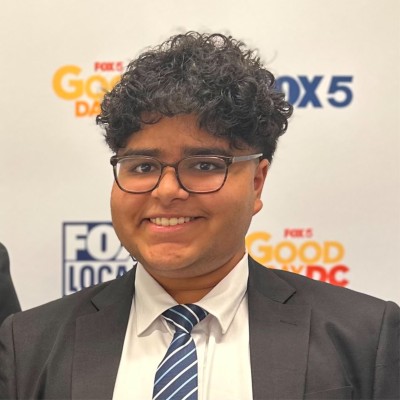
Dev Rai
Herndon, Virginia
The first time I sat in the driver's seat with my learner's permit, my dad did not talk about the gas pedal. He pointed at the side mirror and said, "Everyone you see out there has somewhere to be, just like you." I nodded, adjusted the seat, and pulled out of our neighborhood in Herndon at about fifteen miles an hour. I thought he was being dramatic. A few months later, I understand what he meant. Driving is the most ordinary dangerous thing most of us will ever do, and the only real protection is knowing that every car around you holds a person.
Roughly 34,000 Americans die on the road every year. I spend a lot of my time working with numbers, in finance research and in a financial literacy game I helped build, and I have learned that big numbers have a strange effect on people. They make a problem feel too large to touch. Thirty-four thousand is a stadium. It is hard to picture. But each of those deaths was one driver who looked down for a second, or drove home tired, or assumed the other car would stop. That is why driver education matters so much. It is the one moment where a new driver is forced to slow down and see the person behind the statistic before they ever get the chance to become one.
Good driver education does more than teach the rules of the road. Anyone can memorize that a solid yellow line means no passing. What a strong course teaches is judgment. It shows a sixteen-year-old how long it actually takes a car to stop at forty-five miles an hour, and how much farther it travels if your eyes were on a text when the brake lights ahead came on. It turns abstract warnings into physics you can feel. When I studied for my permit test, the questions that stuck with me were not about road signs. They were about following distance and reaction time, because they made me realize how little room for error a car really gives you.
There are clear steps that can reduce deaths on the road. The first is making driver education thorough and accessible for everyone, not just students whose families can afford private lessons. Many crashes involve young drivers who learned in a rush, with a few hours of practice and a parent who was too busy to ride along. Schools and communities can close that gap with free or low-cost courses and more supervised practice hours. The second step is technology that works with drivers instead of distracting them. Phones already have "Do Not Disturb While Driving" modes, and making those the default for new drivers would remove the biggest temptation in the car. The third step is enforcement and design that protect people who are not in cars at all, like better crosswalks, lower speeds near schools, and lighting on dark roads where pedestrians walk at night.
I have not been in a serious accident, and I am grateful for that. But I have seen how quickly ordinary carelessness shows up. Last spring, I rode home from a club meeting with an older friend who had just gotten his license. At a red light, he picked up his phone to change a song, and when the light turned green he was still scrolling. The car behind us honked, and he hit the gas without really looking at the intersection. Nothing happened. That is exactly what scared me. Nothing happened, so he did not think twice about it, and neither did anyone else in the car. Most dangerous habits feel safe right up until the one time they are not. I did not say anything that day, and I still think about it. Now, when I am a passenger, I offer to handle the music and the maps. It is a small thing, but it takes one distraction off the driver's plate.
As a new driver myself, I am building habits now that I hope will last. My phone goes in the glove compartment before I turn the key. I leave a full three seconds between my car and the one ahead, even when traffic makes it tempting to close the gap. I treat yellow lights as a signal to stop, not a challenge to beat. I also try to drive like my dad taught me, assuming that the driver next to me might be tired, lost, or new, and giving them space to make a mistake without it costing anyone their life.
Helping others become safer drivers starts with the people closest to me. I have a younger sister who will get her permit in a few years, and I want her to learn from watching me that safe driving is normal, not nerdy. I want my friends to know that I will happily ride along and navigate so nobody has to touch a phone. Peer pressure usually pushes teenagers toward risk, but it can push the other way just as easily if enough of us decide that careful driving is simply what we do.
My dad's advice was simple, and I used to think it was too simple to matter. Now I think it is the whole lesson. Every car on the road is someone's parent, child, or best friend trying to get home. Driver education, smart technology, and better habits all come back to that one idea. If we can teach new drivers to see the people around them instead of just the traffic, we can make that number of 34,000 a little smaller every year.
Content Disclaimer:
Essays are contributed by users and represent their individual perspectives, not those of this website.