It's Not a Race, Leave Some Space!
2023 Driver Education Round 2
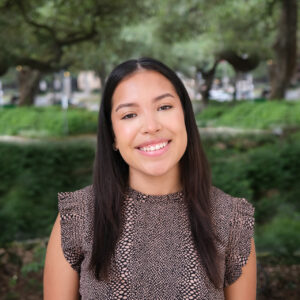
Abrielle Rangel
Bloomington, IN
As a native Texan, I have spent countless hours of my life in a seat of a car; I can drive North for 5 hours and still be in Texas. I can recall so many instances where my family members or friends drove carelessly, putting our lives in danger. Additionally, living in a huge metropolitan city in an equally huge state has its pros and cons. In my hometown of Houston it is nearly impossible to get around town without an engine, and I experienced my first car accident at just 6 years old. My mother was speeding through traffic, I was probably running late for school that day, she accelerated but quickly came upon a stopped car; her brakes screeched, but not fast enough, sending us into the rear of the car in front of us. Thankfully no one was hurt and there were minimal damages, but had my mother failed to brake safely that morning, who knows what the outcome could have been for those of us in the cars. Since that day so long ago, I have sat in many different cars in many different places with many different drivers, and even got my very own car recently! Still, one thing is always consistent: the reality of just how dangerous driving, especially in my home state of Texas, can be. And in the big city, everyone seems to be in a rush.
Every morning this summer I have driven 20 minutes on the 610 freeway to City Hall as an intern for a city council member, and every day the most common form of reckless driving I see is speeding and weaving through traffic, whether on a small city road or an 8-lane highway. As an intern for a council member, I get to sit in on press releases, important city council meetings, community celebrations, and presentations from each of the city’s departments and committees learning so much about the world around me and my fellow Houstonians. Most memorably, I had the privilege of watching a presentation from the Houston Police Department on safe driving techniques. I will admit, I foolishly assumed this presentation might be boring or not tell us Houstonians anything we didn’t already know, but I was proven wrong by two police officers. In the officers’ presentation, I learned that Texas highways are some of the deadliest in the country, a statistic proven by the Texas Department of Transportation. For the past 23 years, there has not been a single deathless day on Texas highways, and the figures aren’t showing any signs of slowing down. Every year, there are as many as 5,000 deaths on Texas roads, that’s almost 14 people killed in motor vehicle accidents every day. These HPD officers took it upon themselves to really show their listeners how speeding and reckless driving affects your arrival time. In their experiment, one officer sped and wove through lanes of traffic on highway 45 while the other followed the speed limit of 60 miles per hour; the difference in arrival times? 19 seconds. These results were shocking, as every day so many drivers are risking their lives for almost no extra time. So, the city was asked the question of how we could possibly bring down these numbers.
It is my belief that community outreach programs and public service announcements showcasing the kinds of statistics and real-world tests those officers did that day in July can truly impact those behind the wheel on our Texas roads. When I sit down in my car every morning heading to City Hall, I remind myself that 19 seconds isn’t worth mine or anyone else’s life. I remind my mother, a once chronic speeder, to slow down. I know that there are many other people like me in the city who value their lives, their families, and the lives of others. In a city like Houston, where cars are an essential part of everyday life, people can only benefit from further education on safe driving. It’s clear that it is not enough to simply issue speeding tickets or hefty fines, we must work together to educate all drivers on safe driving and its positive effects on our lives. Driver’s education is an integral part of the driving experience, and you can never be too safe. It is my hope that one day my home state of Texas will break our 23-year long streak of driving-related deaths and help to increase the lifespans of Texas drivers. We can all remember: it’s not a race, leave some space!
Every morning this summer I have driven 20 minutes on the 610 freeway to City Hall as an intern for a city council member, and every day the most common form of reckless driving I see is speeding and weaving through traffic, whether on a small city road or an 8-lane highway. As an intern for a council member, I get to sit in on press releases, important city council meetings, community celebrations, and presentations from each of the city’s departments and committees learning so much about the world around me and my fellow Houstonians. Most memorably, I had the privilege of watching a presentation from the Houston Police Department on safe driving techniques. I will admit, I foolishly assumed this presentation might be boring or not tell us Houstonians anything we didn’t already know, but I was proven wrong by two police officers. In the officers’ presentation, I learned that Texas highways are some of the deadliest in the country, a statistic proven by the Texas Department of Transportation. For the past 23 years, there has not been a single deathless day on Texas highways, and the figures aren’t showing any signs of slowing down. Every year, there are as many as 5,000 deaths on Texas roads, that’s almost 14 people killed in motor vehicle accidents every day. These HPD officers took it upon themselves to really show their listeners how speeding and reckless driving affects your arrival time. In their experiment, one officer sped and wove through lanes of traffic on highway 45 while the other followed the speed limit of 60 miles per hour; the difference in arrival times? 19 seconds. These results were shocking, as every day so many drivers are risking their lives for almost no extra time. So, the city was asked the question of how we could possibly bring down these numbers.
It is my belief that community outreach programs and public service announcements showcasing the kinds of statistics and real-world tests those officers did that day in July can truly impact those behind the wheel on our Texas roads. When I sit down in my car every morning heading to City Hall, I remind myself that 19 seconds isn’t worth mine or anyone else’s life. I remind my mother, a once chronic speeder, to slow down. I know that there are many other people like me in the city who value their lives, their families, and the lives of others. In a city like Houston, where cars are an essential part of everyday life, people can only benefit from further education on safe driving. It’s clear that it is not enough to simply issue speeding tickets or hefty fines, we must work together to educate all drivers on safe driving and its positive effects on our lives. Driver’s education is an integral part of the driving experience, and you can never be too safe. It is my hope that one day my home state of Texas will break our 23-year long streak of driving-related deaths and help to increase the lifespans of Texas drivers. We can all remember: it’s not a race, leave some space!
Content Disclaimer:
Essays are contributed by users and represent their individual perspectives, not those of this website.