The Streets Remember
2025 Driver Education Round 2
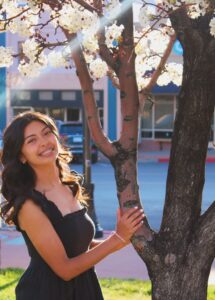
Sophia Michelle Guerrero Loera
Harlingen, Texas
Hearing about the aftermath of car accidents feels safe. It’s all up to your imagination when you hear about cars flipping over or a blown-out tire. But witnessing the leftovers of a car crash is horrifying.
Everywhere I go, it feels like I’m never too far from an accident. The blue and red lights painting the windows of every passing car and glass glittering across the asphalt like snow. A crumpled-up car that looks like a failed origami attempt. Sometimes, it’s just a cracked bumper or a missing headlight. But other times, it’s kids crying on the side. Sometimes, it’s EMTs lifting someone into their van after doing all they could. The streets seem to remember every poor decision, every ounce of recklessness, and they don’t tend to forgive easily.
I haven’t learned how to drive yet. Being taught in a parking lot is incomparable to what millions of drivers are doing daily. It’s not that I don’t want to learn or that Driver’s Ed is hard. But fear is what freezes my body before stepping on the brake pedal to shift gears. The road has taken too many people, and the ones who do survive don’t always walk away whole.
This fear didn’t come out of nowhere.
When I was 13, I was getting my first major haircut at a little strip mall in my city. As my stylist closed her blades on my hair, a thundering boom came from the nail salon next door. A teenage girl and her mom crashed headfirst into the salon, causing the water from the resin bowls to spill, glass from the top of the window to fall, and women panicking to leave the building to escape the claustrophobic room. The problem? The daughter was getting ready to drive off, put the car into the wrong gear, stomped on the pedal, and was blasted into the building. A normal Saturday morning turned into unimaginable chaos.
My dad used to be a pizza delivery driver for Pizza Hut. He was a generally safe driver, and he took pride in bringing one’s food on time, if not earlier. My dad has been crashed into four different times—all of which were teenage drivers. One was looking down at their phone. Another one was drinking straight from the liquor bottle. One crash was caused by a group of teens racing past a traffic intersection like it was a video game when they collided into the side of my dad's old car. My dad was a generally safe driver, but that didn’t matter. His body keeps score and remembers every impact as the arthritis in his joints aches. He works a physically demanding manufacturing job in Utah, and he lives alone, so those crashes have made even the simplest of things harder for him.
My older sister Liz has had her share of it too. When she was 19, she was hit by a 17-year-old boy driving his new 2018 white Porsche. He and his friend were racing on the highway, and he slammed into her as she was trying to exit. Her car spun and crashed into a pole. The airbags deployed, her wrist fractured, and her door was jammed, trapping her inside the car. The crash wasn’t an accident. It was a reckless decision made by two teenagers who were showing off.
When she was 16 years old, she was in the passenger seat of a friend’s car in a quiet Salt Lake City neighborhood. Her friend, who’d been texting behind the wheel, didn’t see the little boy darting across the street until it was too late. The child survived, but he’ll always remember getting hit. It was a situation that could’ve been prevented with one more second of attention, and that one second of distraction changed everything.
I carry the stories and pain of the people that I love.
Even though I don’t drive yet, I still try to protect the people I ride with. If my mom reaches for her phone to send a text, I take the phone and do it for her. If a friend wants a sip of their drink while we’re moving, I hold and offer the cup so their hands stay on the wheel, or I ask them to wait. When my dad starts looking a little tired behind the wheel, I keep a conversation going until we make it home. I know how fast things can go wrong, so I try to be a second pair of eyes because sometimes, that’s all it takes.
I do everything I can to protect the people in the car. But that doesn’t mean I can protect us from everyone else. Because no matter how careful we are, we share the road with others who aren’t as cautious. Cars are heavy chunks of metal that move at high speeds across highways and city streets. They can carry us to beautiful places. You can watch the sunset through the side windows, laugh with your family in the backseat, and see the world in motion. But these same cars—machines that we trust with our lives—can also kill someone in an instant.
According to the CDC, “Motor vehicle crashes are the leading cause of death for U.S. teens.” About 2,800 teens were killed and 227,000 were injured in "motor vehicle crashes in 2020." These aren’t just numbers on a statistic board: they are lives. It’s friends who don’t make it to graduation. It’s birthdays and holidays missed. Futures that have been wiped away and erased in an instant. Substances, speeding, distractions, inexperience, and even improperly using a seat belt are all risk factors that are easily preventable.
That’s why driver’s education matters. It’s not just about memorizing road signs and passing the test. It’s about learning how to keep your hands on the wheel and how to be responsible even when no one is watching. Practicing defensive driving, checking your blind spots, choosing safety over comfortability—the lessons go on. Some don’t get the opportunity to go to drivers ed, and whether it’s not having the time or the money, they will feel “confident enough” to just drive off. So what can we do instead?
Teens can start with accountability. Positive peer pressure in this case can be powerful. If we speak up when a friend is recklessly driving, we can save lives. It takes one voice to say, “Hey, slow down,” one hand to take the phone away, or one reminder to buckle a seatbelt to bring awareness. Being a passenger doesn’t mean being silent. People need to understand and realize how fast everything can change.
Schools could also offer more than driving classes. Providing real-world simulations, bringing in testimonials from crash survivors and crash causes, or even setting up an event with EMTs and traffic officers to explain how crashes work and how dangerous they are would be engaging enough. Integrating modules on distracted driving, drug and alcohol effects, and weather conditions into our education can be life-saving.
Communities, and especially communities, can come together and get involved. Businesses can sponsor safety programs and create incentives—like discounts and gift cards—for safe habits. Cities can run awareness campaigns, especially during holidays, summer breaks, and prom nights—when crash rates are bound to go up. Driver’s Ed programs can push to become more affordable, especially to low-income areas. This gives everyone the opportunity to learn how to drive safely. It’s also important to support the idea that “safe driving is cool.” We should be encouraging this and be proud of it. It shouldn’t be something for teens to defy.
Teen drivers are the future of our roads. What we teach and encourage now will shape the habits of the next generation. I know I’ll learn to drive someday. I’ve held the hands of those who’ve held the steering wheel. So, I’ll save up, take the class, and finally hold that wheel too. And when I do, I’ll remember the sirens, the stories, the ache in my dad’s back, the fear in my sister’s voice, and the way everything can change in one second.
The streets remember. I do too.
And that’s why I’ll never treat driving like it’s just another part of the day.
Content Disclaimer:
Essays are contributed by users and represent their individual perspectives, not those of this website.