
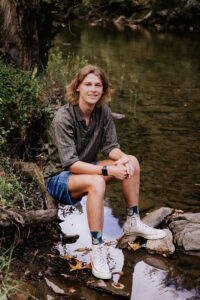
Name: Grayson Whitlock
From: Knoxville , Tennessee
Votes: 0
The importance of drivers education and infrastructure on car related fatalities.
During graduation weekend, a close friend decided to drive home after a party. She was intoxicated but decided to drive home because her parents were expecting her, as she had church the next morning. She made it home without harming herself or anyone else, but after she told me about that evening a few months later I could not stop thinking about what could have happened. My friend was being vulnerable with me as she deeply regretted the drive as it was not her initial plan, so I comforted her, and we both agreed that she should never do that again.
Even after consoling her, I still think about how dangerous driving while intoxicated, or otherwise distracted can be to everyone involved. My sense of danger is intensified by the fact that I ride my bike as a form of transportation while at college and am already afraid of the drivers around me. Bicyclists and pedestrians and inherently more vulnerable to automotive violence and drivers lacking safety skills are more likely to contribute to that violence. That’s where driver education comes into play, teaching drivers the safest methods and best practices could literally lives.
I took driver’s education in high school, and one of the most important things I learned was the three second rule. Never getting closer to the car in front of me than three full seconds, as that is the amount of time that it takes to react and engage the brake safely. A second major takeaway from the class was the acronym S.I.P.D.E which stands for scan, identify, predict, decide, and execute. S.I.P.D.E is a mental process that if followed will help drivers scan and identify obstacles or potential obstacles and react in the safest manner possible. One crucial driver safety idea that is consistently overlooked by drivers, including most of my friends and family, is speeding. I am definitely guilty of speeding a bit in my initial years behind the wheel, but after I started biking, I began to question why I was speeding. I ultimately decided that the risks of speeding are huge compared to the negligible time savings and that even going just 5 mph over the limit could have negative consequences far beyond a speeding ticket. Another benefit of sticking to the speed limit is that everyone behind me also must go the speed limit as well causing the road to be safer as a whole. I have discussed my opinion on speeding with my dad multiple times and I think he is beginning to understand, as when he takes me home on breaks, he stays at the speed limit and pays no mind to the tailgaters behind us. Drivers need to remember that the speed limit is a speed maximum not a speed minimum as it’s often treated.
While driving education is extremely important and the methods, I listed previously will reduce car related fatalities there are more concrete ways to prevent these tragedies. Infrastructure like raised pedestrian crossings, round abouts, and having a tree canopy signal both directly and indirectly that they should drive at slower speeds. These simple yet effective design elements can reduce pedestrian and collision related fatalities.
Driving can be safer with both proper driver education and infrastructure, but ultimately the best way to reduce car collisions and pedestrian fatalities is to reduce the number of cars on the road. While intuitive, this solution is often ignored or labeled as oversimplification. I know that car accidents are most likely to occur close to a person’s home because that is where most of that person’s driving occurs, but what if those short day to day trips could be accomplished without a car? The number of cars would be drastically reduced as would the violent collisions. I have been living this hypothetical for the last 4 months while at college. I bike or walk to class which makes up most of my day to day trips. For longer trips which are less frequent, I’ve found I can still bike most of the time, but when I can’t, I take public transportation or carpool. This is beneficial for public health as a whole and my own personal health as there is one less car on the road and I get a healthy dose of physical activity while in transit.
Between my friend’s risking driving, my journey of understanding the consequences of speeding, and my biking experience I believe I can help reduce the number of cars related injuries and death. I am even involved with a local organization called bike walk Knoxville that I think will create a better future for both drivers, pedestrians, and bicyclists.
