
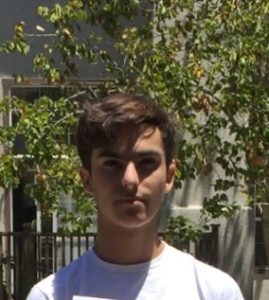
Name: Gonzalo Allen-Perez
From: San Diego, California
Votes: 0
A Window into the Driver’s Seat
A Window into the Driver’s Seat
By Gonzalo Allen-Perez
It doesn’t take long for a new driver to see that the greatest danger on the road isn’t the cars, but the choices made inside them. According to the NHTSA, over 40,000 Americans lose their lives to highway accidents, with millions more injured, when the majority of cases could have been prevented with the principles of defensive driving and sensible choices. While there is more than enough awareness spread on the dangers of distracted driving, just as there is more than enough awareness on the dangers of quicksand, sharks, and the two-party system, what we need as a society to prevent further tragedies is a rework of the driver’s education system and a reimagination of driving culture. Driver education reform holds the key to saving lives on a scale practically unparalleled, and it’s our duty to make sure our next generations have the principles and sense, as well as the foundational knowledge, to stay safe and secure on the roads.
The majority of incidents are the result of individual bad decisions, such as the choice to be distracted, speed, or be intoxicated while driving. Therefore, it follows that the responsibility for preventing things before they happen can not be fixed by legislation alone but instead by emphasizing driver education that arms drivers with the capabilities to be responsible for the safety of themselves and others around them. Specifically, there is a need for a wide curriculum of driver education that focuses not just on the rules and best practices, but also the mindsets, what to do in less than ideal situations, and how to control emotional impulses; additionally, real world experience with capable mentors such as driving instructors should be emphasized more than ever as that is the only way to reduce your own dangerous bad habits. Frankly, the six hours of real world instruction that is required is not nearly enough to build safe habits for all situations across the board and should be increased significantly to at least fifteen. Additionally, I think it is adverse for the industry to be privatized as a whole, as seeking out private companies can be detrimental to the growth of a student when each company holds different priorities in the driver’s ed curriculum and holds students as a source of profit first and foremost. If we centralize driver’s education into a clear path for everyone, we can make sure that everyone is on the same page regarding the rules of the road, and create a system that promotes effectiveness and mastery instead of how fast one can rush through a required checklist. Additionally, public awareness of the consequences of distracted and reckless driving is not enough; as we have seen time and time again, knowing the abstract statistics of driving fatalities does not translate into real world action. The only real path forward is not a one step solution, but instead to transform our cultural identity behind driving to value safety and preparedness over flashiness. As soon as it’s the normal thing to do drive defensively by maintaining a safe speed and following distance, constantly checking your mirror and blindspots, and overall minimizing risk when going out (such as always planning to uber or utilizng a designated driver) and reckless and distracted driving is seen as annoying and undesirable, the social pressure will significantly reduce the idea of doing these things in the first place and make the roads everywhere safer as a result
A personal example of the effectiveness of this approach resides in myself; at first, I thought that I was already a great driver just because I had the technical skill to get from one place to another, and I believed that checking my phone while driving was culturally acceptable to do. However, this confidence quickly shattered the first time I was put into a compromising situation. When I pulled out of my neighborhood as I did practically every day, I casually checked my phone while passing through an intersection. Those few careless seconds were everything. A car pulled out of a parking lot at the same time, and we collided. Thankfully, no one was hurt, but the situation could have been drastically worse. It may have just been a minor collision this time, but what if it was a walking pedestrian instead? I realized then that learning how to drive meant more than following road signs but instead how to be prepared for anything to happen, and that learning how to drive safely is a neverending process. I actively began to implement defensive driving every time I grabbed a wheel, and planned the entire journey for everything that could go wrong. I haven’t gotten into an accident since.
So what can the average person do to become a better driver and help the new generation of drivers? Firstly, anyone can work to de-stigmatize driving safely and effectively, especially when they do not have the experience to back it up. Next, they can prepare for any time they are going to be driving, which can include making it a routine to frequently check up on the maintenance of one’s car and to leave for events with plenty of time to account for traffic and unforeseen conditions. Lastly, train for awkward situations because it’s a matter of when, not if, they are going to happen. If you put all of this in place, it can be ensured that you will have a successful driving career for the rest of your life- and if we all can get together to value human lives over convenience, only good can come of it. See you out on the roads. Let’s hope there isn’t quicksand.
