Name: Srinika Kanneganti
From: Rancho Cordova, California (CA)
Votes: 0
When Driving, Take Turns, Not Lives
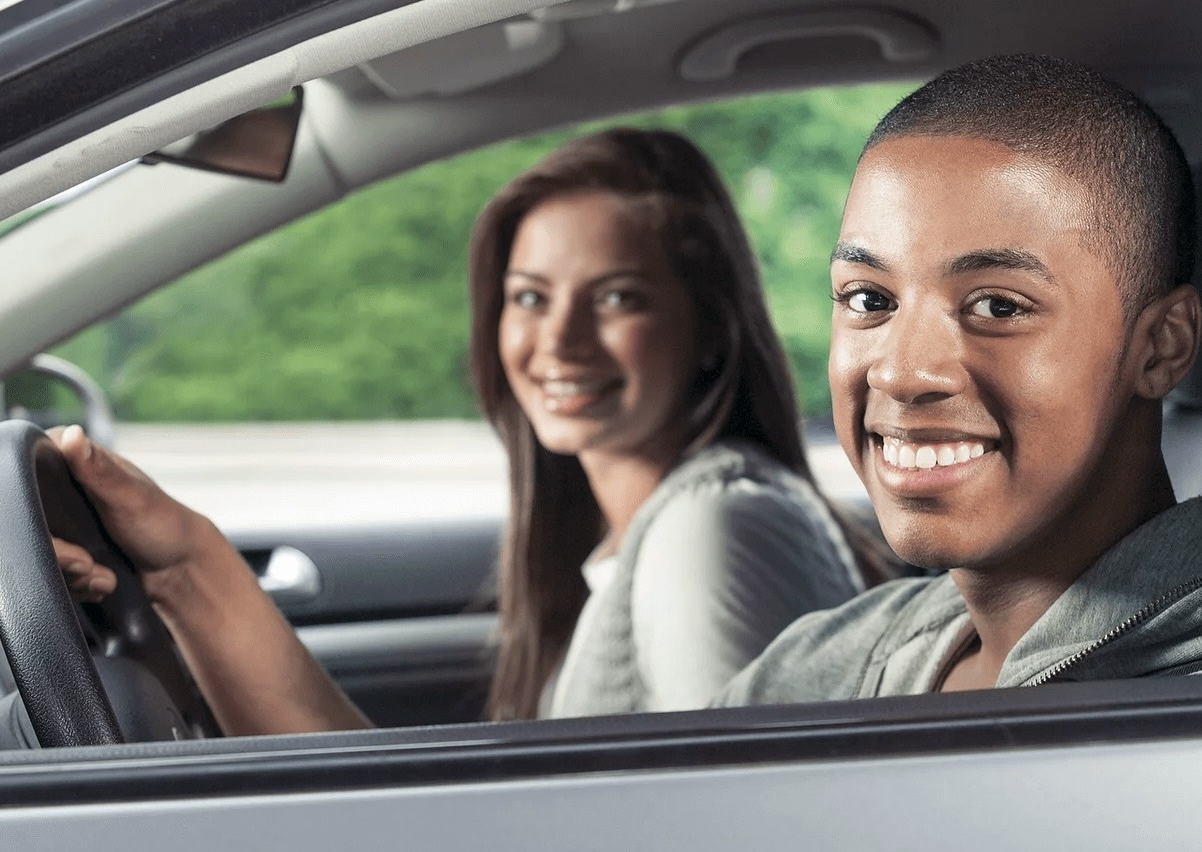
Fender-benders, collisions, crashes, traffic accidents, hits, strikes, wrecks, encounters, impacts. There are countless terms used to refer to driving accidents, a large percentage of which are fatal and cause passengers to walk away seriously injured, if not dead, and while deadly traffic accidents can occur in several ways, there’s only one way to reduce the number of deaths as a result of driving: driver education. Countless immature, naive youth who lack fully developed frontal lobes let their excitement to begin driving blind them from understanding the importance of driver education and first learning the law before heading on to the road, and when such drivers take the wheel, they harm themselves, their passengers, and the vehicles they share the road with. However, it’s not youth who are still learning about their place in the world that are at fault for wanting to drive and simply hoping to unlock a liberating component of the teenage experience, and instead, it’s the lack of emphasis we place on driver education that’s to blame. Teaching our siblings, friends, and relatives to drive not only helps them develop a useful life skill, but also deepens the bond between the new driver behind the wheel and the loved one teaching them, and there’s nothing we want more than for our friends and family to safely guard their lives and those of the people around them, which begins with thorough driver education.
While driver education already exists and American youth are required to either take a Driver’s Education elective at their high school or complete an educational course online before they can even set foot in their local Department of Motor Vehicles (DMV) office to complete a permit test, many teenagers focus on memorizing correct answers, rather than understanding why they’re correct. With the hundreds of websites, apps, and similar easily accessible resources that are available to youth who are studying for their multiple-choice permit tests, the exact questions used in the DMV’s official permit tests are found in a plethora of other applications, both digital and tangible. However, when teen drivers make an effort to understand the rules of the road and learn the law by learning how to share the road with other drivers—many of whom are also fellow youth—instead of whether to select option A or choice B as the correct answer, they become knowledgeable, conscious drivers, who are far less likely to become involved in driving accidents, let alone lose their lives, than their overly enthusiastic, driving-obsessed counterparts. Individuals who put in effort while completing their driver education grow into mindful drivers who understand the possibilities of accidents happening on even the seemingly safest, least harmful roads, and such drivers are aware that not only does their driving pose a risk to others, but that others’ driving also threatens their life. This knowledge, derived from the completion of one’s driver education, leads even the most reckless, carefree teenagers to grow into mature, cautious drivers, as they understand the alarmingly large number of individuals who could be injured or die with a single wrong move, whether it’s failing to turn on one’s indicator before making a turn or unknowingly driving in the wrong lane. Driver education materials, such as DMV handbooks, online courses, and classes offered at high schools, remind drivers to act wisely, which begins with being alert of their surroundings, both the fellow drivers they’re sharing the road with and the natural wildlife that may become an obstacle to them, and properly educated drivers carry this knowledge with them regardless of where they’re steering their vehicle, whether it be a wide, empty road or a narrow one that happens to be packed with cars during rush hour. This aware, conscious mindset that driver education instills in youth leads them to drive safely, as they know that they can take their own life and those of others in mere seconds, thus creating better, safer drivers while contributing to a lower number of deaths caused by driving.
To reduce the number of deaths related to driving, teenagers completing their driver education and learning how to navigate the road should learn in a variety of ways, rather than simply enrolling in a Driver’s Education course at their high school or completing a course online—which they can use AI tools to pass, as the tests are simply multiple-choice questions whose answers are phrases taken verbatim from the DMV handbook. While the requirements to obtain one’s driving permit don’t necessarily need to be tightened or changed, youth drivers should be encouraged to “shadow” their legal guardians, relatives, and friends as they drive, taking note of any potential errors the person driving may be making alongside any smart saves they made with quick thinking, such as recognizing that a nearby vehicle was in the wrong lane before giving them the necessary time and adequate space to correct their mistake. By doing so, not only will teen drivers learn the pros and cons associated with different driving styles (defensive, offensive, passive, assertive, etc), but they’ll also understand the kinds of decisions that drivers have to make on the road alongside how to go about such choices while working towards the outcome with maximum efficiency. For example, many couples have different driving styles, and while one parent drives offensively, the other may drive more passively, enabling their child to understand that while driving offensively may save time due to its aggressive approach, it’s more dangerous than passive driving, which may take more time due to constantly giving way to other vehicles (out of politeness when not completely necessary) but is ultimately safer and less risky.
Additionally, as teenagers don’t have the same cognitive abilities as adults and their older peers, in addition to understanding traffic rules and learning how to operate a vehicle that can reach anywhere between 120-150 miles per hour within seconds, youth drivers should also train their cognitive abilities and skills, such as by training their reflexes. As many seasoned drivers, whether they’re professional taxi drivers or simply adults who drive themselves, their family members, and their friends frequently, will emphasize, quick reflexes and a fast reaction time are necessary for drivers to have, as a delay of even a second in their reactions can either save them from death or put them in harm’s path. While teen drivers don’t need to train their reflexes to the extent that professional racing drivers do, they should at least practice their reflexes with basic sports equipment (e.g. small balls that fit in the palm of one’s hands) or improve their reaction time by using digital resources (there are several websites with fun yet educational and effective games to improve users’ reaction time). Finally, to reduce the number of deaths associated with driving, youth drivers should learn and practice driving with distractions by playing driving simulation games or doing medium difficulty mental math problems while listening to loud music, watching a movie with the volume higher than usual, and having some type of distracting, interesting audio play at a relatively loud volume in the background. Driving is primarily mental, as while drivers must steer their cars in the right direction alongside angle, be able to alternate between the gas and brake pedals while driving, and have the ability to quickly switch gears (if their car is a manual one), in order to do all of these activities, they must have minds that can think quickly, make prompt decisions, and take action with no time to lose. Whether they’re driving their friends to a group hangout while laughing and listening to music blasting at a high volume or taking their younger siblings, who are loud and immature, to school, regardless of the exact circumstances, drivers will have to drive when distractions are present, including the presence of other passengers in the car. Thus, teen drivers should practice driving with both moderate and severe distractions in the car to ensure that even when utter chaos is present in their vehicle, which is filled with noise due to the loud passengers inside it, they won’t miss their exit, drive in the wrong lane, or make any similar errors that could cause a fatal accident.
I understand how fortunate I am to never have been involved in a car accident, which I never hope to be entangled in, let alone be the cause or victim of, but I’ve heard countless stories about horrific traffic collisions, terrifying car crashes, and similar instances of irresponsible driving. A common theme in all of the near-traumatic driving experiences that my loved ones have shared with me is recklessness, a lack of patience, and the assumption that everyone is a perfectly moral, passive driver who follows every rule mentioned in the DMV handbook. Car accidents can be caused by multiple drivers, as while one rash, careless driver may break the law by making a U-turn at an intersection where doing so isn’t allowed, an otherwise competent driver who doesn’t notice that a car on the other side of the road is driving in an illegal manner and continues driving ethically may become a casualty in the harm caused by the driver who violates the law. Essentially, rather than thinking that all of the other drivers on the road are moral, ethical drivers just like themself, one must assume that the people they’re sharing the road with are inexperienced, rule-breaking drivers who willingly put others’ lives at risk to arrive at their destination a few seconds quicker, as not only is this an unfortunate reality, but thinking this way prepares drivers for the challenging experiences which put their abilities to a test that await them on the road. However, as humans are naturally inclined to assume that most people exemplify the traits they prominently demonstrate and are innately biased in this manner, understanding that the majority of drivers don’t follow all of the rules they should abide by can be a challenge, and it’s the cause of many accidents, collisions, and crashes. Additionally, while taking risks is an excellent quality to have in the general world, this trait has no place in the complex, intricate, and life-threatening realm of driving, in which even calculated, limited risks are inadvisable due to the danger they pose. From reckless drivers swerving around the gates at railroad crossings while assuming that they can quickly cross the tracks before the train approaches to careless drivers trying to fit their vehicle in a gap that’s too small while attempting to change lanes, drivers take risks on a daily basis for all kinds of reasons, and whether they’re rushing to an important event or are simply letting their daredevil nature take control, we’ve normalized the execution of dangerous, life-threatening driving maneuvers, which occur on both small and large scales on all kinds of roads, intersections, and highways.
Finally, to be better, safer drivers while helping others do the same, teen drivers must understand the “why” behind everything related to driving, including the behavior of different drivers and the driving styles they demonstrate. Youth drivers must understand why ethical drivers follow the rules they learned, why immoral drivers stray from the law by taking risks, why certain seemingly harmless driving maneuvers are illegal or only allowed in particular circumstances, why understanding the law is more important than memorizing it, and why a minor violation of traffic laws has such major consequences. By comprehending the why behind all of the aforementioned queries, teen drivers will understand why it’s so important that they drive with utmost caution, awareness, and morality. In too many facets of society, we learn how to do things or simply learn general facts about them, but never the why behind them, leading us to take things lightly and assume that a few minor, seemingly insignificant errors (both physical mistakes and intangible errors in judgment) won’t have any real impact. With the introduction of AI into the driving world, such as self-driving cars and such advanced technology, drivers—both teens and adults—have been giving less and less value to the importance of intently completing their driver education, and to combat this, drivers should understand that AI and modern technology is bound to make the same mistakes as human drivers. In the same way that human drivers’ slow reaction times, sluggish reflexes, and inability to make important decisions in seconds pose danger, self-driving cars powered by AI and new technology are equally life-threatening due to their glitches, malfunctions, and technology errors. Overall, instead of memorizing the driver’s handbook found in their local DMV office or spending hours completing mock exams of permit tests to ingrain the right answers in their minds (without understanding them), to reduce the number of driving-induced deaths and traffic collisions, new drivers of all ages, especially youth, must become conscious, mindful drivers who understand the impact of their actions, which begins with observing both safe and dangerous drivers, training their reflexes/reaction time, and learning how to safely operate a vehicle amidst countless distractions. Reducing the violent, life-taking accidents in our world begins with making the road a safer place, which is necessary to ensure the health, safety, and well-being of both drivers and passengers, who comprise all of society.