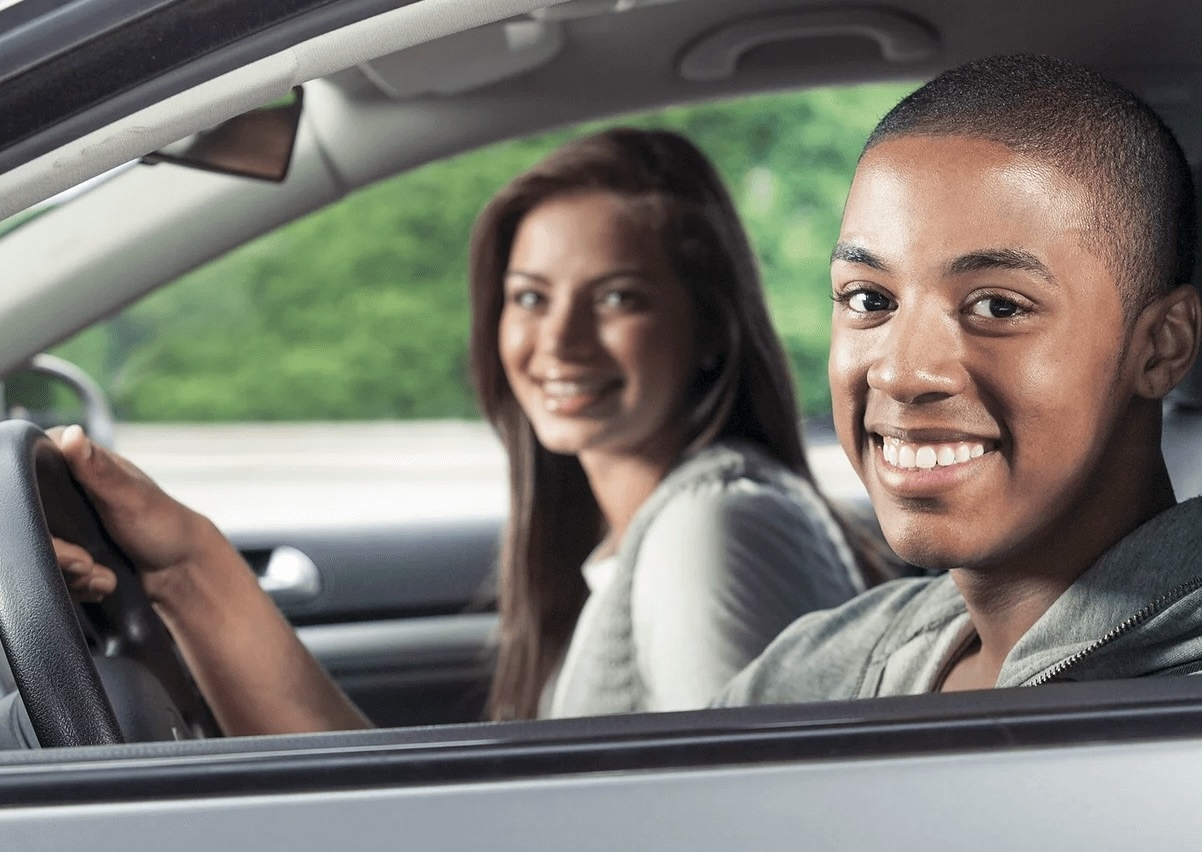
Name: Jonathan
Votes: 0
The Do-Good Driver’s Dilemma
I have always found it odd that adults never expect me to truly understand the rules of the road. Comments such as, “How often do you check your mirrors?” and “You know you have the right of way, right?” always catch me off guard. “I check my mirrors frequently and I know when I have the right of way!” I want to reply. But I keep my mouth shut and nod curtly. For some reason, because I am younger, I am perceived as a worse driver due to “lack of experience.”
I find it ironic that many of the people who criticize me are adults who illegally drove for a time period of their lives when they were my age or do not follow the rules of the road themselves. Older drivers seem to believe that because they have been driving for longer that they can handle the road better, and this leads to overconfident driving. Even with my parents, as I sit in the car on the highway and watch the speedometer climb to 75 miles per hour and then 80, I can’t help but feel discouraged that everyone expects me to drive safely when they do not.
In my opinion, driver’s education is vital for producing safe and experienced drivers. I recall one time when my dad explained how he felt the system set up in the United States doesn’t m+ake much sense for educating adult drivers from other countries. The reason for this is because adults from other countries who have received a license in their home country don’t need to learn the material to receive a license in the United States. My dad said that when he came to the United States, he went to the DMV to get a license. However, he said the situation was rather awkward since he had driven there without an official license, and, if, theoretically, his tester failed him, he would have to drive home regardless. Therefore, there isn’t much chance of failing in the first place. Meanwhile, teenagers who really have their best interests set on learning to become safe drivers have to undergo a long course and take a test on road theory, before they can even think about driving. Once receiving a permit, they must take three instructed lessons and drive for fifty supervised hours. At the same time, I observed teens who had families who did not care and signed their forms for fifty hours when they only had twenty. Other teens broke the law and simply drove without a license.
What was the point, then, of this process? One might think. Well, for one, I feel that, having driven for fifty hours with my parents in the car to help offer me advice, and, with them being sticklers about things such as the speed limit and remaining observant, I’ve turned out to be quite a good driver. This is why, when some people say I have a lack of experience, I feel frustrated: because I had already driven well over fifty hours with my parents in the car on the first day that I drove alone. It is easy to assume that someone younger will have less experience, and, in theory, this is true, because someone my age, assuming they follow the rules and do not drive at an illegal age, hasn’t had the same time frame to practice driving. However, being educated helps quite a lot. I took an additional course in order to become eligible for insurance, and this course focused on more precise aspects of driving, such as mirror positioning, spatial analysis, and hazard identification. If all teens— nay everyone— underwent such a course, I am sure there would be far fewer accidents. While I did know how to operate a vehicle beforehand, after this course, I understood how to navigate the road safely.
An important part of this course analyzed the effect of distractions on driving. What is distracted driving? Well, it’s— Oh what’s this that my friend just sent me? — smash! In our modern times, everyone lives with a constant distraction in their pockets: a phone. We can receive calls, text messages, notifications, reminders, and more with ease, but this comes with a cost. Many people don’t understand that having their phone available for contact as they drive can be the most life threatening thing on the road. Even just the sound of a notification, without the intent of viewing it, shifts one’s attention off the road and moves it elsewhere, making people more susceptible to accidents. To segway into a preventative measure, I want to explain that I find that listening to music helps me remain calm and focused on the road. Whenever I drive, I utilize a mode on my phone, which is conveniently called “Driving,” that allows me to prevent any notifications from reaching me. Through my phone’s settings, I was able to request that “Driving” mode be activated whenever I connect to the Bluetooth mode on my car’s stereo system. This way, I can listen to my music, stay focused, and not receive any notifications as I drive. The way “Driving” mode works in more depth is that it prevents all texts from going through until I turn the mode off, and, if someone calls me, they need to call twice to get through, so only people who really need to reach me do so while I’m driving. I think everyone should utilize this feature because it ensures that nothing can come between you and your attention to the road.
A couple of additional safety measures which seem relatively simple but should not be overlooked are that one should always put on a seat or safety belt. When in a car crash, a seatbelt could be the difference between life and death. In 2017, seatbelts saved a reported 15,00 lives– and that’s in the United States alone. Therefore, it is of the utmost importance that people in a vehicle, whether or not they are in the driver’s seat, wear their seatbelts. Additionally, it can never hurt to make sure that the vehicle being driven is in good condition. For example, the brakes should work properly, the motor should be well-maintained and not out of date, and the tires should not be too worn, so that they can work properly in difficult situations, such as sudden braking or all-terrain. This all contributes to reducing the chance of an accident and increasing the chance of survival in the event of a collision.
On a separate note, I find it confusing when people say they are better drivers and proceed to break the rules. This, by default, makes them a worse driver because they have broken the most important rule: taking unnecessary risks on the road. For example, my coworker loves to brag that they are a better driver than I with such confidence it almost makes it funny. However, when they pull up to the red light at the first right turn to leave our work parking lot, they don’t even stop before continuing their turn. Important rule of the road: stop on red. Of course, since it is a right turn, they could proceed after fully stopping and ensuring the road is clear, but the problem is that they believe they are prepared to cope with anything so they stopped bothering with that rule. This is the overconfidence I was referencing earlier. Another common thing I observe when I drive in the car with other adults, is that they rarely stick to the speed limit. Most people drive at least five miles per hour faster than the speed limit. Even though it is true that you should drive at the speed of the traffic, is it really the right thing to do if everyone else is speeding crazily? I feel that, for example, on Wolfe Road, a busy road near me, where there are two lanes, the right lane is understood to be for people who drive the speed limit and the left lane is for people who are speeding. Why do people speed? There are many reasons. Perhaps they are late. Maybe they are preoccupied with something else on their minds or are driving with emotion, as I call it (road rage). Whatever the reason, I think it would help people to know that, at the end of the day, reckless driving rarely saves more than two to three minutes of time maximum. Why do all that dodging and weaving, increase your chances of getting into a crash, and endanger other drivers and pedestrians when you could simply accept that the time you will arrive was set in stone when you left your starting point. If that doesn’t suit people, they could leave five minutes earlier. Think about it as getting your Starbucks (or whatever it is that wakes you up in the morning) five minutes earlier.
But can I be a safer driver and can I affect how safe others drive? The answer is always yes for the former and most of the time for the latter. There is always room for improvement. Moreover, practicing safe driving on the road helps others do the same by default. For example, if there are two lanes and one is already at the speed limit, while the other tends to be faster, if I choose to drive in the left lane and drive at the speed limit, this forces the drivers behind me to do the same as well. As much as people would argue that this would cause more danger because people from my lane would try to dodge and weave to get around me, more often than not, the people behind will simply be resigned to driving at the speed limit. Such a shame…I almost feel bad…almost. But they can’t even be angry with me because I’m following the rules. That’s one way to force people to drive safer. However, tailgating can occur and other problems may follow as well, so there is one other way to help, which, I will admit, comes with less risk. Practicing safe driving habits at all times such as making sure that you maintain a safe following distance and checking your mirrors once every so often all help. It may feel frustrating to be a single safe driver among few others, but, at the same time, if individuals begin to fight for their own right to drive safely by driving safely, I believe this trend will spread back in the direction it came from (people used to drive safer than they do). Know that you are not alone in your endeavor to make the roads safer and that your choices do have an influence on those around you, however small.