
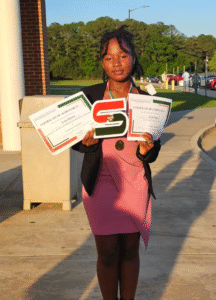
Name: Aysia Massey
From: Stockbridge, GA
Votes: 0
Stay in Your Lane (Literally and Figuratively)
Have you ever caught sight of a happy dog with its head sticking out of a car window, its tongue sticking out and flapping in the wind? The dog’s fur ruffles playfully as it takes in the scents of the passing world, eyes sparkling with pure joy and excitement. There’s a certain magic in this carefree moment that resonates deeply with drivers and teenagers alike, evoking a feeling of freedom and a sense of adventure that comes with driving on the open road. But unlike the dog, who trusts the ride without thinking, teen drivers have the responsibility of controlling the car, along with the responsibility for their lives and the lives of others.
Teen driver safety is one of the most important public issues affecting young people today. According to the CDC, car crashes remain a leading cause of death for teenagers in the U.S. While driving offers freedom and independence, it also comes with very real dangers—especially for teens, who lack experience and often underestimate the risks involved. Whether it’s distracted driving, speeding, lack of experience, or poor judgment in tough conditions, teen drivers face multiple challenges that can easily lead to life-changing consequences. And the problem doesn’t just affect teens—it impacts families, communities, and anyone else on the road.
Driver’s education plays a key role in addressing these dangers. I always thought driver’s ed would be a boring checklist of traffic rules and signs, but it turned out to be one of the most eye-opening learning experiences of my life. Our instructor didn’t just talk about speed limits or how to merge on a highway. She shared stories, real stories, about students who made mistakes behind the wheel and didn’t walk away from it. One video we watched showed how just 10mph can cause injuries in a crash. That story shook me, because I saw how easy it was for something I considered to be “cruising” to become irreversible damage.
When I had my first driving lesson, I realized how different real-life driving is from sitting in a classroom.I was practicing in a mostly empty parking lot, feeling confident, when suddenly a couple of kids ran out from their car and dashed in front of mine. I slammed on the brakes, stopping just in time. My instructor said I did the right thing, but the incident left me shaken. It was a stark reminder that anything can happen in an instant, and you must stay 100% focused at all times..
Distraction is definitely the biggest danger for teen drivers today. We live in a world where everyone is constantly connected to their phones. I’ve seen friends text at red lights, try to skip songs on Spotify while driving, or check GPS without pulling over. It only takes a second of looking away to miss something crucial. Sometimes I wonder if we’ve all become too used to multitasking—even when it could cost us our lives.
Experience is something you only get with time, and that’s hard because you don’t know what you don’t know. When I first got my license, I thought I was a decent driver—until I had to drive in a storm for the first time. The rain was heavy, and visibility dropped fast. My windshield wipers were working at full speed, yet visibility was still poor, and those new LED lights on cars weren’t helping at all. I decided to slow down and take my time, but my heart was pounding in my chest. Every time a car zoomed past me, I gripped the steering wheel a little tighter. I eventually made it home safely, but it hit me that experience can’t be rushed—you can only accumulate it, one mile at a time.
To truly promote safer driving for teens, we need more than just rules—we need a culture that values safety. That means action on multiple levels. For teens, it starts with holding ourselves accountable and supporting each other. If a friend is texting while driving, we shouldn’t be afraid to speak up. If we know someone who’s not ready to drive safely, we shouldn’t pressure them to. Even things like agreeing to be the “designated DJ” in the car or helping with directions can help reduce distractions.
Schools have a big role to play, too. Driver’s ed should be more interactive and real. Instead of just PowerPoints and worksheets, we need simulations, guest speakers, crash survivors, and hands-on scenarios. We need education that connects emotionally, not just intellectually. A speaker who lost a sibling to distracted driving might make more impact than any textbook ever could.
Communities can also step up by supporting safe driving initiatives. Local police departments can host teen driver safety nights. Cities can create awareness campaigns that actually speak to teens in our language, through social media like Instagram or TikTok. Insurance companies and local businesses can offer rewards for safe driving habits, like discounts or giveaways for teens who complete advanced driver’s training or stay ticket-free.
One idea I’ve always loved is a peer-led driving safety club at school. If teens are the ones setting the example and talking to each other, the message comes across stronger. Whether it’s making posters, hosting events, or just encouraging good habits, peer influence can be powerful—especially when it’s used in a positive way.
In the end, teen driver safety isn’t just about avoiding tickets or passing your road test. It’s about making a commitment, to yourself, to your family, and to everyone else who shares the road with you. We all want the feeling of freedom, the wind in our hair, the thrill of the drive, but we also want to get home safely. That happy dog with its head out the window may live in the moment, carefree and trusting. But as teen drivers, we don’t have that luxury. We have to be alert, prepared, and responsible, because the choices we make can last a lifetime.
With the right education, support, and mindset, we can turn that feeling of freedom into something truly meaningful: safe, smart, and confident driving for life.
