
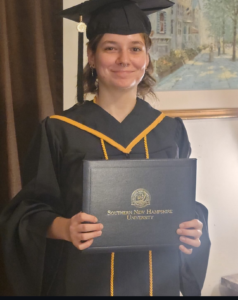
Name: Ashley Marie Gish
From: New Hampshire, MA
Votes: 0
A Recognizable Truck, a Near Miss, and a Wake-Up Call
As someone who attended a small, underfunded high school in Hayden, Alabama, where driver’s education was required for all students, I find it unacceptable that so many schools still treat driver’s education as optional. If our school could manage it, so can others. It should be non-negotiable. Driver’s education doesn’t just teach technical skills; it saves lives.
One night when I was sixteen, I learned firsthand how fragile life on the road can be, even if you aren’t the one behind the wheel. My best friend had just gotten her license, and we were driving home from a late movie. It was a quiet night, and the roads were nearly empty. We were laughing, talking about nothing, and the music was turned up a little too loud, playing our favorite artist. Then her phone buzzed. She glanced down. Just for a second.
That second was enough. She missed a stop sign at a rural intersection. A truck with no headlights swerved just in time to avoid hitting us, but we ended up skidding into a ditch. No one was hurt, but we were shaken. The most terrifying part? My best friend didn’t even realize how close we had come to being killed.
We planned to keep the whole thing a secret. Neither of us wanted to admit what had happened. We were full of shame and afraid of what our parents would say. We brushed off the mud from her truck and tried to laugh like nothing had happened. But as we pulled into her driveway, we saw her mom waiting on the porch, arms crossed and eyes wide.
What we didn’t know was that her mom’s friend had been driving a few cars behind us. She recognized the old blue single-cab pickup my friend always drove. It’s a small town, and an even smaller high school, so everyone in town knew that truck. She saw the whole thing. When we missed the stop sign and landed in the ditch, she pulled over, panicked, and called my friend’s mom in tears. She watched us get out, unscathed, and opted to let my friend’s mom handle the disciplining. By the time we got to my friend’s house the phone call had already happened.
Her mom rushed to the car, hugging us both, shaking, crying, and asking what we were thinking. That was the first time I saw an adult cry because of a driving mistake.
The guilt I felt wasn’t because I was the one driving. It was because I hadn’t said anything. I saw her glance at the phone. I didn’t stop her. I thought it wasn’t a big deal. That night, I realized just how dangerous silence can be. And how quickly things could have gone another way.
Teen drivers face overwhelming challenges: distractions, overconfidence, peer pressure, and most of all, inexperience. Many don’t realize how quickly things can go from fun to fatal. Texting, loud music, and friends encouraging risky decisions only make it worse. Even when we know better, we sometimes stay quiet because we don’t want to seem dramatic or ruin the mood.
Driver’s education helps lay the foundation, but schools must do more. Simulators, peer-led conversations, and actual hours behind the wheel in challenging conditions could give teens the experience and perspective they need to handle pressure. It shouldn’t take a near-accident to learn how serious this is.
When I got my license later that year, I carried that night with me in everything I did. I practiced driving in the rain, in the dark, and on the highway. I talked to my siblings about safe driving. And I made a promise to myself: I would never be silent again if someone behind the wheel made a dangerous choice.
We also need our communities to do more. Hosting teen-led safety campaigns, offering refresher courses, and encouraging parental involvement can reinforce what we learn in school. And schools must treat driving education like the life-saving instruction it is—not an elective, but a requirement.
That night in the ditch didn’t just scare me—it changed me. It showed me that being a safe driver isn’t just about how well you drive. It’s also about how willing you are to speak up, how prepared you are to handle the unexpected, and how seriously you take your responsibility behind the wheel.
If every student had access to real, immersive driving education, and if communities worked together to make road safety part of our culture, we wouldn’t have to learn these lessons the hard way. Driver safety starts with education—but it’s shaped by accountability, experience, and empathy.
And it starts with us.
