
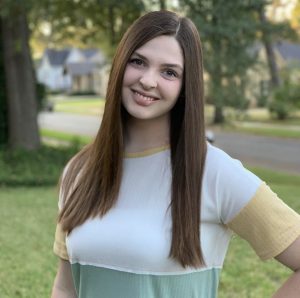
Name: Hannah Noel Hobson
From: Shreveport, LA
Votes: 0
In the Driver’s Seat
My eyes are trained on the road, absorbing the colors of traffic lights and blinkers, but they cannot help but flicker to the rearview mirror. The first adjustment I make when I sit down in my vehicle is to this mirror, positioning it to precisely align with the rear windshield and to allow me to observe the cars behind me. When I say my eyes flicker to the rearview mirror, I mean that they compulsively check its reflection, anticipating a crash from behind. . .a repeat of the accident that totaled my first car.
The back of my gray Toyota was smashed into, the front grinding into the car ahead of me as I veered to the left. While the wreck left only a seatbelt-inflicted bruise on my arm, months later my heart still pounds in anxiety when a vehicle trails me too closely or doesn’t put the brakes on in a timely fashion.
Despite my compulsive rearview-mirror checking, nothing can be done to prevent someone from rear-ending my car because drivers are responsible for their own awareness. I will never know why the woman who caused the wreck failed to notice the red light I had stopped for or the glow of twenty brake lights. I do know that my wreck, sad as I was to say goodbye to my car, could have resulted in much more serious consequences.
Reflecting on my driver education lessons, I was relieved to be able to tell my parents that the wreck wasn’t my fault. It only takes one moment–one second of shifted focus from the road–to risk your life, but that distraction isn’t worth the risk. Teenagers are prone to believing they are invincible: the “that will never happen to me” mindset. However, even in the most cautious of circumstances, unfortunate events do occur on the road.
Drivers education courses provide driving techniques and accident-prevention fundamentals, and the driving practice that follows is instrumental. The message from the course is clear: stay alert, know the laws, and never trust other drivers to be perfect. The videos, speakers, and worksheets that reinforce this have undoubtedly saved numerous lives, but the real predicament of driving-related deaths is not rooted in the classroom instruction, but in the hands-on practice.
While I now feel adequately equipped to handle the road on my own, driving with a feeling of ease developed slowly at first. I feel that this development would most likely have been accelerated by more instructor-guided time behind the wheel. For teenagers especially, who prefer to ignore the reality of danger and are being entrusted with their lives inside a car at sixteen, these hours with an instructor are highly essential. I feel that more of these hours would decrease the number of deaths related to car accidents greatly. More hours spent with an instructor would prepare teenagers for driving on their own more easily, producing a greater number of calm and alert drivers less prone to accidents.
