
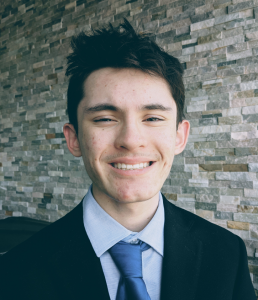
Name: Eric C. Mathemeier
From: Winter Garden, Florida
Votes: 0
Solutions to Problems Facing Modern Roads
Ever since I was 2 years old, my grandfather loved to take me to Disney World. He’d drive to come and pick me up from Preschool and take me to every Disney Park. And even though I can’t remember most of it, I do remember when I would say, “Disney? Again?” I never realized until recently how I took that time for granted. About a year ago, my grandfather got into a car accident. Thankfully, the car was the only casualty. The woman behind him was putting makeup on when she didn’t slow down and hit him at a stoplight. She claimed it was my grandfather’s fault, but ultimately the judge and jury sided with my grandfather. I’m beyond grateful that my grandfather wasn’t harmed, but since then I’ve learned the importance of being a careful driver.
That woman most likely took Driver’s Education as a teenager because it’s required to get your license. But just taking the class and having your license doesn’t mean you’re one hundred percent safe on the road. Driver’s Ed teaches you many important topics, but, in my opinion, it doesn’t enforce those topics well enough. I was taught that you can’t drive too fast in the rain, but in my home state of Florida, rain is the only other type of weather besides scorching heat. And living around Disney World, we have thousands of tourists come through each day. So, none of them know how to drive in the kind of weather we have. We have people speed down roads in the downpouring rain, people on our highways drive slower than a turtle taxi service, and people run red lights constantly like they’re the only person on the road. Driver’s Ed teaches about all of these topics, but to my point earlier, it doesn’t enforce them enough. If these ideas and rules were enforced and engrained into the driver’s brain, the driver would be able to weigh the consequences and make a rational decision to not run the red light.
America, and countries around the world, are currently working on building self-driving cars. One of my friends owns a Tesla and took us for a ride once. While it was very fun and the dashboard options were very entertaining to play with, I immediately thought of an issue with it. The self-driving car does not, can not, and will not ever have the intuition and instinct of a human being. In December of 2020, the United States Military showcased an AI-controlled aircraft for the first time. An article from Engadget highlights the main problem, showing that “it’s not hard for these systems to be fooled by human ingenuity.” Now while planes might not be the ordinary vehicle we encounter on suburban streets, we can see the problem with AI-controlled vehicles. They don’t have the discernment of a human and might make worse decisions depending on the situation.
AI-controlled vehicles aren’t the only problem facing the roads, however. Drunk driving, driving under the influence of drugs (DUI), and distracted driving are all issues that the modern world must tackle. While we can’t prevent all forms of reckless driving, we can take steps to make sure that our roads are safer and more clear of these kinds of drivers. Firstly, any bar or restaurant that serves alcohol can stop people from driving before the effects wear off. A bar can have someone at the door that prevents a drunk person from getting into the driver seat of their car, and can instead offer to call rideshare or friend for them to drive them home instead. Or they can have the person wait for the alcoholic effects to dissipate before they drive again. Secondly, we can introduce sensors into everyday vehicles to make sure that the person driving is fully sensible and capable of operating the vehicle. Sensors that make sure someone is drowsy or half-asleep. If they aren’t they’re free to drive. But if they are, the car locks the steering wheel and gear shift until the driver either becomes fully aware or gets out of the car. This would reduce the number of car accidents caused by drivers DUI, and also reduce the number of arrests. Third and finally, probably the hardest one of them all to stop, distracted driving. But just because it’s hard to stop doesn’t mean we shouldn’t try. Just like the woman that hit my grandfather’s car was doing, applying makeup and grooming oneself is a form of distraction. To reduce the chances of this happening, cars could have a system that detects when someone doesn’t have both or either of their hands on the wheel and employ an AI-controlled “pull over” system. The benefit to this is that it forces the person to regain control of the car or let it pull over so they can finish what they’re doing. While this may seem contradictory to my earlier point about AI-controlled vehicles, the AI is not the one in control of the situation, the driver is. They can choose to let the AI pull over the car, or regain control and continue on their way. Another way to reduce the chances of distracted driving is a “mini-EMP” setup in the car. When you enter into a car, the car’s interface senses your phone, tablet, or any electronic device, and connects to it, turns it off, and then turns it back on once you exit the car. This reduces the chances of you scrolling through social media and missing a green light, bending down to grab it when it falls, and, most notably, texting while driving.
Of course, none of these methods comes without risk. However, none of our modern-day inventions came without some form of risk either. If this is a problem that we want to solve, a problem that we believe could be prevented, we should take the necessary steps to do so. I, personally, will continue to get more educated. I will take those necessary steps to ensure that I will be the safest driver I can be. Not just for my safety, but the safety of the other people on the road as well. The safety of the people that I coexist with. The safety of the people I share this earth with. Because if we can’t share a road safely, how can we ever hope to share a whole planet safely?
