
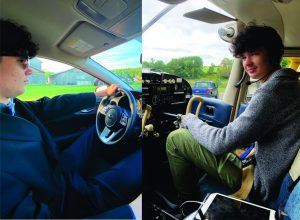
Name: Jonathan RYAN
From: Schenectady, New York
Votes: 0
Different Vehicles – Same Attitude
I was flying before I could drive in the State of New York. With the COVID pandemic restricting my access to the Department of Motor Vehicles sites, the opportunity to get my license on my 2020 April’s 16th birthday was impossible. Yet, armed with a mask and proper health safety measures, I was able to keep on track my journey to earning my pilot license.
While some people argue that the car driving age should connect to maturity, the age paradigm prevents us from accepting an important point. The fact is, that comprehensive safety and hazards identification education is the best investment in accident prevention.
Interestingly enough, in the State of New York, a young new driver is only required to complete a five-hour pre-driving course that thinly covers safe driving practices. Many other states in the country require 20 to 30 hours of formal driver’s education. In contrast, the aviation national standards are delivered equally to all. In aviation, instructor-guided education is a requirement. The rigorous FAA process not only covers safety practices, it goes beyond to establish habits that save lives. This includes conducting pre and post-flight safety checkpoints, understanding the flight instruments, and preparing flight plans. After experiencing both preparation strategies I felt compelled to share my view. With vehicle accidents exceeding the death risk by the exposure and by the number of operators, we would all benefit from making the 30 hour driver’s education requirements a national pre-requisite standard.
Not all accidents can be prevented. I was only ten years old when a bicycle collided with my father’s car. I will never forget the look of despair on my father’s face. The kid drove his bike across the road without stopping. No driver’s safety course would have prepared my father to forecast this accident, but what he learned about speed limit compliance and the need for alertness, helped him stop just in time not to injure the boy or cause his death.
Keeping everyone safe begins with an attitude. When a pilot approaches a plane, they suddenly adopt a different mind frame… a formal and professional attitude. To be allowed behind the controls, one must demonstrate respect for the safety and operations process. In contrast, for many car drivers, the relaxed approach is similar to wearing a comfortable pair of jeans. They jump on the car and go! I have never observed, my friends or even in my family, anyone who conducted a pre-drive checkpoint.
From this perspective, there are some steps that drivers, especially young drivers, should take to prevent accidents. First and most important, invest in the driver’s education process. Understanding road hazards and safety practices are the foundation to respecting the risk and consequences of driving. For a pilot, the strict FAA rules structure the operations, for vehicle drivers, success relies on the student’s willingness to assimilate the choosing to apply it every day.
To become a safer driver is to accept the responsibilities not only for your acts but for the reckless acts of others. Just like a pilot watches all the instruments to guide the flight, a driver must watch for people who will miss the stop sign, turn without using the signal, or fail to stop because of texting. The rear camera and mirror have become one of my best friends, and monitoring the space behind the vehicle when backing up has prevented accidents.
Timing your trips and charting the course is another practice to adopt when driving. Before heading out, a pilot must chart the journey understanding the departure and arrival time by forecasting the conditions. A driver could benefit from the same practices. When heading on a more extended trip, a driver should take time to research the weather conditions, consider any traffic roadblocks, and understand the route, find challenges on the road, and identify construction or bad weather. In most cases, when the arrival time is delayed, most people speed as the correction choice… the wrong choice. A travel plan, just like a flight plan, is a proactive way of preventing chaos and stress.
Becoming a private pilot at the age of 17 taught me to value my formal education and preparation. The process changed my approach to operating a vehicle. Today, preparing for a flight is a well-formed habit I follow and respect. Similarly, the same behavior is now impacting my driving. I conduct my driving plan with my cell phone prior to starting a trip. Without thinking, I embrace proactive practices to prevent accidents because it has become a routine. You can go through the course and just check off the box or view it as a life preservation skills preparation.
Because the requirements are different for driver’s education versus aviation, choosing the right attitude is the key. Engaging and embracing the learning from driver’s education is the key to proactive practices. Behind the controls of an airplane or the wheel of a vehicle, one has the opportunity to adopt a mindset. Choosing to behave in a manner that protects everyone’s lives is the best attitude.
