
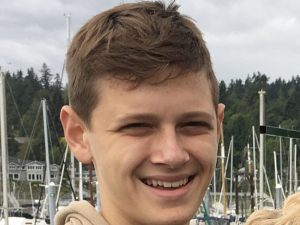
Name: Michael Rafko
From: Scottsdale, AZ
Votes: 0
Hope
My passion is to evolve the definition of technology’s limitless creativity and innovation to include “for the betterment of society.” I plan to major in computer science and am eager to address the challenges we face from technology over-reaching into our privacy. Attending university will improve my mind academically and nurture my spirit and heart to solve what I believe is one of the biggest problems we face.
I believe the depth of character of a highly selective university’s students and faculty will create the environment needed to understand the social and political conflicts created by over-reaching technology. Moreover, the academic rigor will provide the technical foundation to avoid those often-salient conflicts.
My motivation to address this issue is very personal. John, my best friend, struggled with drug addiction throughout high school. John’s obsession, combined with his addiction to social media, led to a severe accident and DUI. Though the accident occurred near our high school, we are fortunate that no one was seriously injured. However, the DUI has already had significant impacts on John’s life, and it will likely continue to haunt him. His first disappointment was not pursuing his lifelong dream to become an Army Ranger. Unfortunately, the Army does not allow DUIs.
John has been sober for over two years and is now living independently. My friend held onto hope, and it led him to sobriety. Hope is within everyone’s reach if they are willing to open their hearts to the reality that a better life is possible if they believe!
Once John became sober, he and I discussed what he believes triggered his drug use. He said it was the feeling of inadequacy and how others lived such an exciting, glamorous, and fulfilling life and how his life seemed so empty. What made it so difficult for him is that the people on social media were not famous, Hollywood people, but the people he went to school with and sat next to in class. This experience made their media seem that much more “real,” Eventually, he turned to opioids to escape his reality.
I specifically want to stop the addiction to social media. As a teenager growing up in a technologically savvy generation, it is hard to escape the corruption and toxicity of social media. Every day, people post the “best moments of their lives” and create envy and jealousy within their peers or people that they don’t even know. Social media is no longer a platform for interacting with others but a means of tearing others down to make oneself feel superior.
I am willing to fight against the urgent need to post rather than enjoy the moment, fight against our decreasing attention span, and fight against our addiction to social media. But what I am most willing to fight for is social media’s fundamental construct that encourages users to create digital lives for their gain at the expense of others.
The impact of social media on one’s ability to focus on driving is significant. The average attention span was 8 seconds compared to 12 seconds in 2000. This number will likely continue decreasing as technology becomes even more advanced and addicting.
Social media has a direct impact on the four main types of driving distractions, yet, as shown below, social media continues to perpetuate, rather than address the distractions:
-
Visual – looking at something other than the road: Social media has become more visible and more temporary. Snapchat is one of the most popular social media platforms. The principal feature of Snapchat is that pictures and messages are usually only available for a short time before they become inaccessible to their recipients.
-
Auditory – hearing something not related to driving: Alerts of social media posts not only produce an audible alert on our phones but with Bluetooth connected cars, often interrupt music and even appear on the screen of the phone and car audio screen.
-
Manual – manipulating something other than the steering wheel: Social media addiction ultimately leads to manual entry of likes, posts, sharing
-
Cognitive – thinking about something other than driving: Social media hijacks our mind as we engage in conversations or tap into our deepest fears and anxieties. John’s mind became so consumed that drugs seemed to be the only means of masking the pain, and when he was not taking drugs, his mind focused on pushing out the pain that the pings from social media perpetuated.
The Bible teaches us that helping people is in our nature: Hebrews 13:16 “Do not neglect to do good and to share what you have for such sacrifices are pleasing to God.” Therefore, technology and doing good can, and must, coexist.
