
Name: Alexandra Elyse Hershfield
From: Lutherville Tim, MD
Votes: 0
Simple Steps to Reduce Driving Deaths
Every year, thousands of people die in motor vehicle crashes. Tragically, many of these deaths are teenagers. With each teenage life lost, parents lose children and families are forever broken. It is hard to fathom how a parent overcomes the death of a teenage child. However, if a few simple steps were followed, the number of deaths could be greatly reduced and families would be spared the life-altering devastation of burying a child.
First, wearing a seat belt must be mandatory. Any technology in a car, including apps that notify parents when their child is not wearing his or her seat belt, should be installed. Additionally, all passengers should be required to also wear their seatbelt. Data from the National Highway Transit Safety Administration reveals that wearing a seat belt can reduce the risk of crash injuries by approximately 50 percent.1
We must also continue to emphasize that no driver should get behind the wheel if they are impaired by alcohol, illegal drugs, prescription drugs or insufficient sleep. The National Sleep Foundation found that 55% of drowsy driving crashed involved those under 25 years old.2 Businesses and communities can address this by offering free and convenient rides to and from events where alcohol or drugs might be involved. Parents should also consistently discuss with their children that they will pick them up, wherever and whenever, if they feel impaired.
Especially for teens, we must also continue to reinforce that being on time for a class or your job is not worth your life, the safety of a passenger, or other innocent drivers on the road. Teenagers must learn to drive at a safe speed, even if that speed is less than the speed limit and even if other drivers on the road are making the teenage driver feel uncomfortable. School lessons can always be learned the next day, but a death caused by speeding to class lasts forever.
Graduated drivers programs, similar to one enacted in Louisiana. The Louisiana Graduated Driver Licensing (“GDL”), should be enacted in every state. The GDL limits the number of passengers a driver is allowed to have in their vehicles. For example, until a driver earns his or her full, unrestricted driving privileges, the new driver cannot transport more than one (1) passenger under the age of 21 between the hours of 6:00 p.m. and 6:00 a.m., unless it is a family member or unless accompanied by a licensed adult. Limiting the number of teen passengers greatly reduces the risk of distracted driving for a new teenage driver.
Parents also have an obligation to their children to be a good driving role model. They should be sure to practice safe driving in front of their children and set aside ample time to take their new teen driver on practice driving sessions. Parents should lead by obeying the rules of the road and never speeding with a teenage driver in the car. For example, parents should emphasize the “3 second rule” so that the teenage driver stays three seconds from the driver in front of him or her. Also, to the greatest extent possible, parents should ensure that teenage drivers avoid night-time driving. Instead, new drivers should initially focus on driving during the day to build experience, situational awareness and confidence.
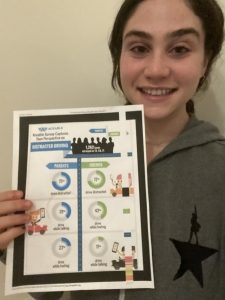
Perhaps most importantly, in a world of instant communications, cell phones should be turned off or the driver should install a cell-phone blocking app when operating his or her vehicle. This message must constant and consistent. Phone calls, even hands-free phone conversations, are extremely dangerous.3 Similarly, texts and emails should never be sent or read while operating a car. Also, the car stereo is not in the car to transform the car into a concert hall. Rather, the radio should be kept at a reasonable level, or turned off altogether, so that the driver is not distracted. Teenagers also eat and drive which is extremely distracting. If the driver is hungry, the driver should pull over and eat. The 10 minutes spent eating can save your life and the lives of others.
Finally, teenagers often believe nothing tragic will happen to them and they are strong and smart enough to multi-task while drive. This thinking can lead to horrific results especially for young drivers. We must continue to educate all drivers, especially teenagers, through repeated reinforcement at school, at home and through public service campaigns in all forms of media, so that these simple steps can be followed and driving deaths can be reduced.
